The practical answer: keep takeaway gelato cold on the journey, put it in a stable freezer location promptly, limit repeated warming and re-freezing, and soften only the portion you intend to serve. If large ice crystals have already formed, careful serving can make the texture less harsh but cannot rebuild the original microstructure.
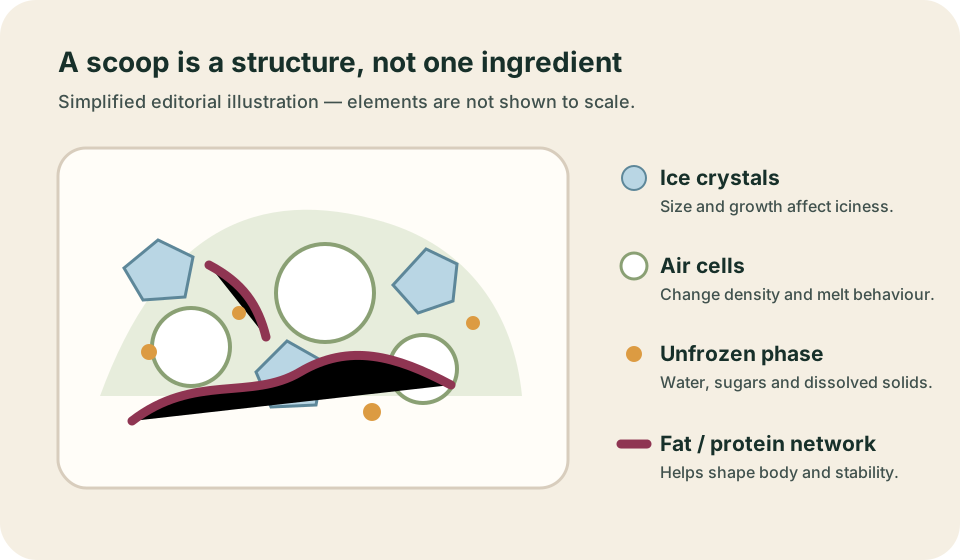
What is inside the scoop?
A frozen dessert is not a solid block of uniformly frozen liquid. It contains ice crystals, air cells and a concentrated unfrozen phase, alongside recipe-dependent fat, protein and other solids. The structure formed during manufacture continues to respond to storage temperature and temperature changes.
Smaller ice crystals are generally experienced as smoother than large crystals. Air affects density and collapse during melting. Sugars and dissolved solids leave part of the water unfrozen at normal serving temperatures, which is one reason that sugar performs a structural job as well as supplying sweetness.
This explains why a simplistic “remove the sugar” instruction often fails. Changing one component moves several properties at once: freezing point, hardness, sweetness, body and flavour perception. Reformulation is a balancing task, not subtraction.
The texture damage chain
- Warming. Some ice melts and the unfrozen phase becomes more mobile.
- Re-freezing. Melted water does not necessarily return to the original crystal pattern; existing crystals can grow.
- Repetition. Several warm–cold cycles provide more opportunity for coarsening and structural collapse.
- Perception. The product may feel gritty, icy, shrunken or uneven even if the recipe has not changed.
A 2025 controlled study of dairy and non-dairy frozen desserts found that warmer frozen storage produced larger ice-crystal pores and coarser sensory scores over time, with the warmest tested condition showing the clearest deterioration. The formulations and twelve-week experiment do not reproduce every domestic freezer or artisan gelato, but they support the practical direction: stable, sufficiently cold storage protects texture better than warmer storage.
From counter to freezer: the hand-off plan
| Stage | Action | Why it helps | Do not assume |
|---|---|---|---|
| Ordering | Ask for a secure, freezer-suitable container and lid. | Reduces leaks, air exposure and avoidable handling. | Decorative paper packaging is always freezer-ready. |
| Journey | Make gelato the last collection and use an insulated bag with a cold pack for a longer trip. | Slows warming before home storage. | A product that still looks solid has had no temperature change. |
| Arrival | Transfer it to the freezer promptly. | Limits further melting and shortens the warm phase. | The refrigerator is a suitable holding place for later re-freezing. |
| Placement | Use a stable, cold part of the freezer rather than a frequently opened door shelf. | Reduces exposure to routine warm air. | Every point in a domestic freezer has the same temperature. |
| Serving | Remove only what you plan to portion, keep the lid on while it softens slightly, and use a clean scoop. | Limits warming of the remainder and protects flavour from freezer odours. | Hardness should be corrected with a microwave or hot water inside the tub. |
A readiness test is better than a universal timer
Freezer temperature, container size, recipe and room temperature all change softening time. Instead of promising one number, use three observable checks:
- Spoon entry: the spoon can enter with steady pressure rather than chipping the surface.
- Edge response: the edge yields without a ring of liquid forming.
- Aroma: the flavour becomes perceptible before the product turns glossy or slumps.
Check at short intervals and serve once those signals align. Avoid microwaving the container: heating is uneven, can damage packaging, and creates liquid pockets that may refreeze into coarse crystals. Follow any instructions supplied with a packaged product.
Diagnose the texture before “fixing” it
| What you notice | Likely possibilities | Useful action now | Limit of the action |
|---|---|---|---|
| Rock-hard but visually even | Very cold storage or a firm formulation. | Keep covered and allow brief, controlled softening; test with the spoon. | Does not change the underlying recipe. |
| Large, sharp crystals | Temperature fluctuation, partial melting and re-freezing, long storage, or formulation factors. | Soften only enough for immediate serving and pair with a contrasting soft component if desired. | Large crystals cannot be made small again at the table. |
| Gummy or elastic body | Formulation, temperature or serving conditions. | Try a slightly colder serving and compare a fresh portion. | A serving adjustment cannot diagnose the formulation. |
| Fast watery collapse | Warm service, fruit/water balance, air structure or formulation. | Serve a smaller portion in a chilled bowl and eat promptly. | Slower presentation does not prove better quality. |
| Freezer odour or dry surface | Poor seal, long storage or surface dehydration. | Discard a compromised surface portion if appropriate and improve sealing next time. | Do not use appearance or smell to override use-by or safety instructions. |
Texture quality and food safety overlap, but are not identical
Frozen storage slows microbial growth; it is not a sterilisation method. The Food Standards Agency advises chilling, freezing and defrosting food properly, following product instructions, and avoiding re-freezing food that has been fully defrosted unless the applicable guidance makes that safe. For a ready-to-eat dairy dessert, the conservative household choice is to avoid allowing the tub to thaw fully and then freezing it again.
Domestic freezer recommendations commonly use approximately −18°C as a reference. A displayed setting is not the same as a measured product temperature, and domestic appliances fluctuate. If reliable temperature control matters, use a freezer thermometer and the manufacturer’s instructions rather than judging by motor sound or frost.
Do not use texture advice to override a damaged seal, a power-cut safety concern, a use-by instruction or doubt about how long a perishable product has been warm. When safety is uncertain, follow current official guidance or discard the product.
Method and limitations
This page translates frozen-dessert microstructure research into a conservative household decision path. The storage study cited used two standardised formulations and four controlled temperatures over twelve weeks; it supports the direction of the advice but does not establish a shelf life for your product. Recipe-specific label and seller instructions take priority.
Production disclosure: AI assisted drafting and front-end implementation. Samuel "Sam" Harrison checked the visible content and sources, and Dr Elena Vance (Independent culinary nutrition consultant with responsibility for dietary and allergen fact-checking) completed independent review on 25 August 2026.
Sources
- Sinclair, N., McGregor, J. and Dawson, P. “Effect of storage temperature on frozen dessert quality using scanning electron microscopy and a trained sensory panel.” Exploration of Foods and Foodomics, 2025;3:1010104. DOI. Accessed 25 August 2026.
- Scholten, E. “Ice Cream.” Wageningen University & Research, 2014. Research record. Accessed 25 August 2026.
- Food Standards Agency. “How to chill, freeze and defrost food safely.” FSA guidance. Accessed 25 August 2026.
- Food Standards Agency. “The effects of consumer freezing of food on its use-by date.” 2021 evidence assessment. FSA research PDF. Accessed 25 August 2026.